Page 1 of 2
Cast Bullets, the .30-06, and Going Heavy
Posted: Fri Aug 14, 2026 4:26 pm
by Bigslug
Been wanting to do something like this for years, but it took a couple of side roads for the knowledge and opportunity to come together.
And yeah. . .I'm still trying to lure Zee to the Dark Side with bullet casting. Even if this project doesn't do it, it will be fun to bring you along for the ride.
THE FIRST PROBLEM: Cast bullets cannot be thrown as fast as jacketed for several reasons. One of them is an "RPM threshold" caused by your rifling's rate of twist that exceeds a cast bullet's material capabilities. Without getting into the weeds of the technicalities, all we need to know for this discussion is that with the industry standard 1-10" twist for factory .30-06 barrels, the wheels usually come off your accuracy cart somewhere above 2100 fps when shooting cast. There are guys going significantly faster with custom slow twist barrels, but as I'm shooting a lot of historical toys, here we are.
THE FIRST SOLUTION: If you can't throw something fast, it stands to reason that you should compensate by throwing something big. There are a lot of good 200 grain .30 caliber bullet molds out there. I have several. . .
BUT WHAT I'VE REALLY WANTED for years is 220 grains. It's the original FMJ bullet weight for the .30-06 / .30-03 left over from the pre-spitzer and .30-40 Krag days. Yeah, it gives up some trajectory (I do that with 2000 fps cast bullets anyway), but it has the potential to gain a lot of penetration. This takes us into the territory of W.D.M. Bell using his 175 grain round nose 7x57's to hunt elephant, so there is - admittedly - a boyish desire to create Walter Mitty's Dangerous Game Rifle here. Which brings us to. . .
THE SECOND PROBLEM: 220 grains fills up a lot of room. One of the tenets of cast bullets in bottlenecked cases is that you want your base and lube grooves enclosed in the bullet's neck and not creeping back into the powder chamber. On a plain base, this prevents erosion of the nice sharp edges of the base that you want for accuracy, and on a gas-checked bullet (which we're using here), it keeps a poorly-crimped check from falling off into the case. That's the hard limit for seating depth on the back. The hard limit on the front of course is where the bullet contacts the lands when chambered. Standard groove diameter for American .30 cal is .308", and with cast, we usually size our bullet shanks between .309" and .311" for good sealing of the barrel. BORE diameter, however, is .300", and you have to make sure that your bullet stays enough below that diameter in the nose to be able to chamber.
And yeah. . . it also has to fit in the magazine.
THE SECOND SOLUTION: So I got in touch with Accurate Molds and did some back and forth to custom-design THIS:

- 31-225A Blueprint.jpeg (106.1 KiB) Viewed 1090 times
What we've got here gives me very nearly the .30-06's max overall cartridge length of 3.340" when seated with the gas check at the back of the case neck. The front-rear length of the gas check cup and the taper at the front of the .310" driving shank and .299" nose (A.K.A. "the bore-ride section") give me a little play, but it took some serious farting around with other bullets across multiple rifles to figure out where all those diameters and lengths wanted to be.
So, I was pretty darn giddy when this showed up:

- 31-225A Mold 2.jpeg (107.76 KiB) Viewed 1090 times
I've come to like iron molds. Heavier than aluminum; not as heavy as brass; yeah you have to oil it to prevent rusting in storage, but the output is nice. . .so very nice!. . .Hmmm. . .possibly out of room for pics on one post. Let's try a second. . .
Re: Cast Bullets, the .30-06, and Going Heavy
Posted: Fri Aug 14, 2026 4:31 pm
by Bigslug
As I was saying. . .output:

- 31-225A sized & unsized.jpeg (51.25 KiB) Viewed 1088 times
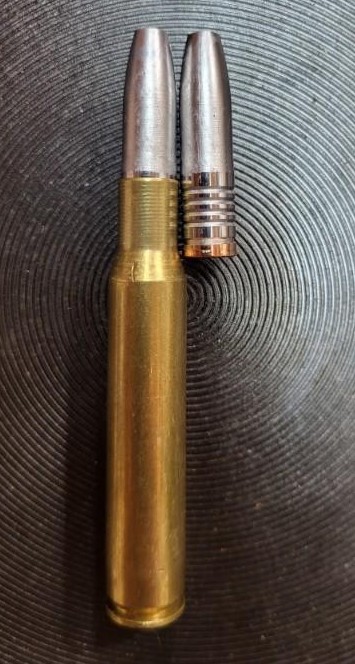
- 31-225A Loaded.jpeg (75.33 KiB) Viewed 1088 times
Straight out of the mold and with a gas check crimped on and base sized to .310", ready to be tumble lubed. Sample round loaded to just shy of max .30-06 COAL.
Plan is to try IMR 3031 for the initial load workup as I have it on hand not doing much else, and it's got a widespread following as a cast bullet propellant across many different cartridges. If that's a dud, we'll try others. Outcome to follow.

Re: Cast Bullets, the .30-06, and Going Heavy
Posted: Fri Aug 14, 2026 4:32 pm
by PFD45
This should be interesting.
Good science!
Will those work in a magazine or single load?
Re: Cast Bullets, the .30-06, and Going Heavy
Posted: Fri Aug 14, 2026 5:06 pm
by CPJ 2.0
I like that. Would be pretty nifty in a .300 blackout.
And Zed will NEVER cast bullets. Ever.
Re: Cast Bullets, the .30-06, and Going Heavy
Posted: Fri Aug 14, 2026 5:21 pm
by Bigslug
PFD45 wrote: ↑Fri Aug 14, 2026 4:32 pm
Will those work in a magazine or single load?
Magazine. There was a fair bit of work done to ensure it. I've got a 200 grain mold with an almost identical nose that I made test rounds with. I seated them WAY out long; the driving band that far forward wouldn't allow the bolts to lock up, but it did allow me to test feeding of the nose profile with max allowable COAL / magazine fit.
My pre-'64 M70 had some issues feeding from the left side of the magazine (flat nose ran into the right side rear of the chamber entrance). . .until I swapped in the follower from my Hawkeye. Another Hawkeye follower is on order from Ruger. . .
Re: Cast Bullets, the .30-06, and Going Heavy
Posted: Fri Aug 14, 2026 5:23 pm
by Bigslug
CPJ 2.0 wrote: ↑Fri Aug 14, 2026 5:06 pm
And Zed will NEVER cast bullets. Ever.
I think he's somewhere between this:

- Luke INJY.jpeg (17.76 KiB) Viewed 1081 times
...and this:

- Luke NOOO!.jpeg (20.31 KiB) Viewed 1081 times
Re: Cast Bullets, the .30-06, and Going Heavy
Posted: Fri Aug 14, 2026 5:35 pm
by Bigslug
CPJ 2.0 wrote: ↑Fri Aug 14, 2026 5:06 pm
I like that. Would be pretty nifty in a .300 blackout.
If the current suppressor/NFA fight continues to go well to the point that we can own that stuff in CA, you can bet your ass I'll be looking into a Blackout bolt action. As it stands, I've not yet had cause to really geek out on it's chamber dimensions.
But the cool thing about Accurate Molds: you can find a blueprint you like in their catalog and request that they lengthen here, shorten there, add or remove a gas check shank, set the base and bore ride diameters to be what you want with your alloy mix, etc...
I own a bunch of NOE molds and they are (usually) great for off-the-shelf, standard dimensions drawn up around known cartridges, but for old, weird, and unique, Accurate will make what you want, so long as it's not a hollow point or base and you can live with a non-pointy nose meplat of 0.18" or bigger. They've got blueprints for the French Chassepot needle rifle, the Civil War Maynard, the stock chamber throat for the .348 Winchester, percussion-to-catridge conversion Colts - pretty much name it.
Re: Cast Bullets, the .30-06, and Going Heavy
Posted: Fri Aug 14, 2026 6:02 pm
by Zee
CPJ 2.0 wrote: ↑Fri Aug 14, 2026 5:06 pm
I like that. Would be pretty nifty in a .300 blackout.
And Zed will NEVER cast bullets. Ever.
Nope.
Re: Cast Bullets, the .30-06, and Going Heavy
Posted: Fri Aug 14, 2026 8:54 pm
by Bigslug
Zee wrote: ↑Fri Aug 14, 2026 6:02 pm
CPJ 2.0 wrote: ↑Fri Aug 14, 2026 5:06 pm
I like that. Would be pretty nifty in a .300 blackout.
And Zed will NEVER cast bullets. Ever.
Nope.
I play with 800F molten metal, you play with poisonous snakes. We've all got our kinks.

Re: Cast Bullets, the .30-06, and Going Heavy
Posted: Sun Aug 23, 2026 2:25 pm
by Bigslug
Nothing miraculous to report. At least not yet.
I fired the 50 round ladder test covering the min/max range for this powder and bullet weight. The good news is that 3031 seems to be a good powder for giving a pretty smooth velocity progression. The bad news is it never gave me the usual progression of sticking 2-6 rounds really close together, then settling onto a new point of impact as the charges increased.
These two were the low end:

- IMR 3031 Ladder Test Group 1.jpeg (204.63 KiB) Viewed 950 times

- IMR 3031 Ladder Test Group 2.jpeg (193.35 KiB) Viewed 950 times
The next two targets got muddied when the POI shifted markedly high on target #4 so they were impacting on #3. Potentially useful info on them, but pointless to post without a lot of explanation.
But I got five potentially useful flat spots in the velocity curve to test out to see if this powder/lube/rifle combo is going to work.
SCIENCE!!!
Re: Cast Bullets, the .30-06, and Going Heavy
Posted: Sun Aug 23, 2026 3:33 pm
by JunkCollector
Mid 28 looks pretty good
Re: Cast Bullets, the .30-06, and Going Heavy
Posted: Sun Aug 23, 2026 3:45 pm
by Wambli Ska
Shows promise and looks like fun. I’ve been thinking about doing some cast 30-30 loads for fun.
Re: Cast Bullets, the .30-06, and Going Heavy
Posted: Sun Aug 23, 2026 5:17 pm
by Elk Creek
That looks like ton's of fun! Those would be fun in Tom’s and my 1885 30-30’s! I wonder if H4895 would be a good powder. You can use it for reduced loads all the way trough full house you load 60% of a FULL load to start and go up. You can find the notice on hodgdon’s site.
Re: Cast Bullets, the .30-06, and Going Heavy
Posted: Sun Aug 23, 2026 6:14 pm
by Bigslug
4895 is a possible. . .
I had really, REALLY stellar results with a 194 grain bullet and 36 grains of H414, EXCEPT for occasionally getting a very slight delay in ignition. Operating theory is that this was due to H414 being a spherical powder and the reduced-for-cast charge was not lighting off uniformly.
H414 being a spherical equivalent to 4350. . .leads me to thinking that H4350 may be the next thing to try. Part of this project is to - maybe - find an accuracy load with powder that isn't doing much else. . . but you gotta find an accuracy load first.
Another thing occurred to me to try this morning: I designed this bullet to be a tumble-luber, BUT. . .(1.) you have to run it through a push-through sizer to seat the gas check anyway; (2.) running it though a conventional lube-sizer might give a more consistent bore-to-bullet state; and (3.) conventional lube-sizer process may actually be slightly faster than the push-through, followed by tumble-lube process. One of the frequent challenges with gas check bullet designs is that sometimes you have to muscle them on to the bullet base and/or use the sizer to do the muscling for you - - emphatically and happily NOT a problem with this mold. I've never really done a load comparison based solely on lube methods before, so decided that I'm going to cast up some more and shoot the same velocity flat spots on the ladder test graph with conventional lube in the grooves. That should tell us SOMETHING definitive. If neither approach looks like it's going to group with IMR3031, we'll move on to other things.
AA5744, IMR4198, and IMR4227 are all pretty commonly used as fuel for cast bullets and are in the medium-fast burn rate camp. 5744 has a lot of potential because it is bulky and eats up a lot of the .30-06's extra case volume. There's also a school of thought based around more gentle acceleration with the slow burners like 4831, but some of those guys are using Dacron fillers to reduce powder movement in the case - this I would prefer to avoid for simplicity's sake.
At any rate, this is likely to be a project: After I solve the "one rifle" problem, I want to create a load that works acceptably well across multiple rifles. I've got three .30-06's that are bug-holers with their dedicated jacketed or copper hunting loads; if I can get something that's under about 1.5 MOA across all of them as a milk jug buster, I can probably call it "DONE".
Re: Cast Bullets, the .30-06, and Going Heavy
Posted: Sun Aug 23, 2026 7:21 pm
by Elk Creek
I have “the one” rifle in a 30-06 problem solved, at least for me. I thought why get a bolt gun in 06 it’s like standing in the debate cream shop and saying I’ll take a scoop of vanilla. I managed to find a Browning 1895 in ought six. That is my one rifle….
Re: Cast Bullets, the .30-06, and Going Heavy
Posted: Sun Aug 23, 2026 8:25 pm
by JunkCollector
Elk Creek wrote: ↑Sun Aug 23, 2026 7:21 pm
I have “the one” rifle in a 30-06 problem solved, at least for me. I thought why get a bolt gun in 06 it’s like standing in the debate cream shop and saying I’ll take a scoop of vanilla. I managed to find a Browning 1895 in ought six. That is my one rifle….
One rifle..... doesn't sound very Garand to me.
Pinging elkcreek
Re: Cast Bullets, the .30-06, and Going Heavy
Posted: Sun Aug 23, 2026 10:14 pm
by Bigslug
Take heed of the man with only one .30-06: his priorities are so far out of whack he's likely to do anything.
Re: Cast Bullets, the .30-06, and Going Heavy
Posted: Sun Aug 23, 2026 11:18 pm
by Elk Creek
Bigslug wrote: ↑Sun Aug 23, 2026 10:14 pm
Take heed of the man with only one .30-06: his priorities are so far out of whack he's likely to do anything.
I have a couple 30-06 Kurtz…..aka 308 if that makes you feel better…..

Re: Cast Bullets, the .30-06, and Going Heavy
Posted: Sun Aug 23, 2026 11:20 pm
by Elk Creek
JunkCollector wrote: ↑Sun Aug 23, 2026 8:25 pm
Elk Creek wrote: ↑Sun Aug 23, 2026 7:21 pm
I have “the one” rifle in a 30-06 problem solved, at least for me. I thought why get a bolt gun in 06 it’s like standing in the debate cream shop and saying I’ll take a scoop of vanilla. I managed to find a Browning 1895 in ought six. That is my one rifle….
One rifle..... doesn't sound very Garand to me.
Pinging elkcreek
Someone has delusions of Garandure……
Re: Cast Bullets, the .30-06, and Going Heavy
Posted: Sun Aug 23, 2026 11:21 pm
by Elk Creek
Bigslug wrote: ↑Sun Aug 23, 2026 10:14 pm
Take heed of the man with only one .30-06: his priorities are so far out of whack he's likely to do anything.
I do shoot a 30wcf out of a Winchester single shot rifle so you may be right…..
Re: Cast Bullets, the .30-06, and Going Heavy
Posted: Sun Aug 23, 2026 11:57 pm
by CPJ 2.0
If you have to size them to cram the GC on them, yeah. Lube them at the same time.
Re: Cast Bullets, the .30-06, and Going Heavy
Posted: Mon Aug 24, 2026 1:01 am
by mitdr774
Bigslug wrote: ↑Sun Aug 23, 2026 10:14 pm
Take heed of the man with only one .30-06: his priorities are so far out of whack he's likely to do anything.
What if you have 5 along with two that used to be .30-06 but are now something else-06? To be fair, of the 5 one is a future donor, one may be a future donor but it does well, one is my first -06 and was put together for a trip I went on with my dad (22 years ago..), and two will go ping if I ever take them to the range. I think I need to look for some more.......
Re: Cast Bullets, the .30-06, and Going Heavy
Posted: Mon Aug 24, 2026 1:46 am
by Bigslug
CPJ 2.0 wrote: ↑Sun Aug 23, 2026 11:57 pm
If you have to size them to cram the GC on them, yeah. Lube them at the same time.
Two different processes.
The NOE push-through sizer is a nifty setup that I install on a Rock Chucker press that pushes them upwards, nose-first, through the die. This is done as a dry process, though some guys will spray the bullets with case lube. Follow up afterwards is usually tumble lube, or if you're a glutton for punishment, you can run them through a lube sizer as well.
The RCBS and Lyman lube-sizers you're probably familiar with shove the bullet base-first into the sizing die, which is also perforated for lube to flow through and do a hydraulic squishy into the bullet's lube grooves.
The RCBS/Lyman approach is great if the checks click right on. If they don't, there's often a messy flow of lube into voids that shouldn't be there.
Since this mold is REALLY well behaved for installing gas checks, the lube sizer approach may be slightly more efficient than push-through with the added step of swirling tumble lube on the bullets in a mixing bowl.
Re: Cast Bullets, the .30-06, and Going Heavy
Posted: Mon Aug 24, 2026 2:03 am
by CPJ 2.0
/:laughsinpowdercoat:\
Re: Cast Bullets, the .30-06, and Going Heavy
Posted: Mon Aug 24, 2026 3:48 am
by Bigslug
CPJ 2.0 wrote: ↑Mon Aug 24, 2026 2:03 am
/:laughsinpowdercoat:\
Maybe slightly more likely for me than getting Zee to cast, but only slightly. Certainly not for a tight tolerance bore riding nose at any rate. We may talk again when running them through a can becomes a real possibility.
And now I'm trying to shake the image of CPJ in front of an Easy Bake oven. . .

